Construction Calculators
- Updated Jul 2026
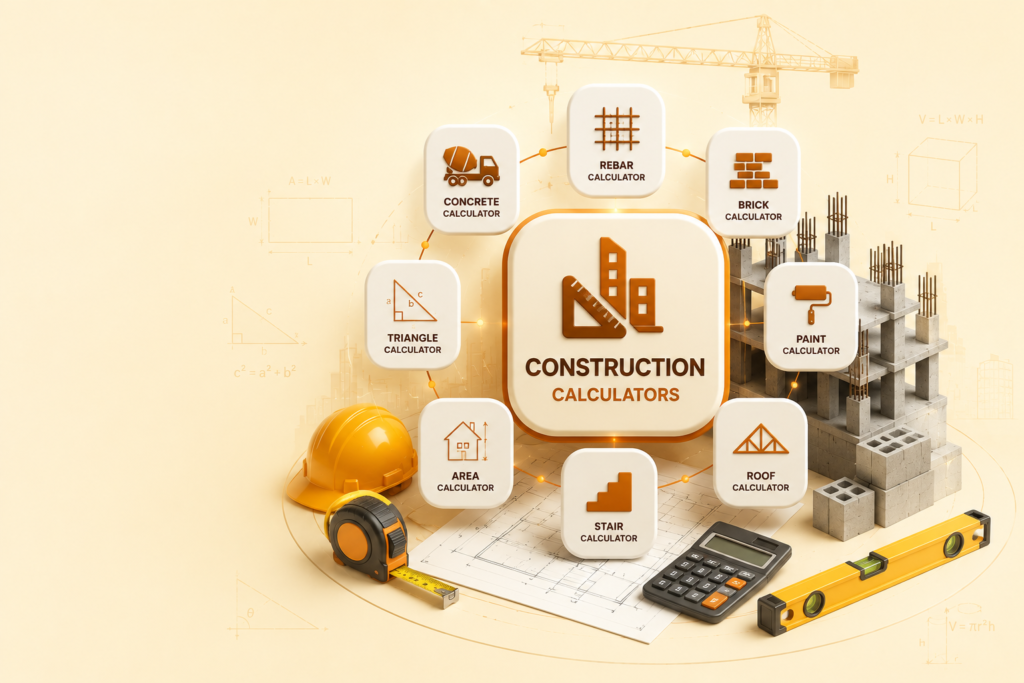
Every construction calculator on this page answers the same expensive question: exactly how much material do I need? Enter your real measurements and get precise quantities for concrete, lumber, paint, drywall, gravel, roofing and more — with a recommended waste allowance built into every estimate. Contractors use these tools for fast on-site estimates; DIYers use them to walk into the hardware store with a shopping list instead of a guess. Each construction calculator shows the formula behind its result, so you can verify the math before you spend a dollar on materials.
- Concrete & Masonry
- Earthwork & Landscaping
- Roofing & Exterior
- Framing & Lumber
- Interior Finishing
- Measurement & Conversion
Most Used
Popular Construction Calculators
The three tools builders and homeowners reach for most:
Concrete Calculator
Cubic yards or meters of concrete for slabs, footings, columns and stairs — plus the equivalent number of pre-mix bags and a spillage allowance.
Square Footage Calculator
Area of any room or plot — rectangles, circles, triangles, or combined L-shapes — in square feet or square meters, ready for flooring and real estate.
Paint Calculator
Wall dimensions in, doors and windows subtracted, coats chosen — exact gallons or liters to buy, based on standard coverage per can.
Group 1 of 6
Concrete & Masonry Calculators
Concrete and masonry mistakes are the most expensive to fix, a short pour can mean a cold joint in your slab. These tools calculate volumes, bag counts and unit quantities from your exact dimensions, with industry-standard waste factors applied.
Concrete Calculator
Volume for slabs, footings, columns, stairs and curbs in cubic yards or meters.
Concrete Bag Calculator
How many 40, 60 or 80 lb pre-mix bags your pour needs, with cost estimate.
Brick Calculator
Bricks and mortar bags for any wall size, with standard or custom brick dimensions.
Concrete Block Calculator
CMU block counts for walls and foundations, including fill and mortar.
Rebar Calculator
Rebar lengths, pieces and total weight for slabs and footings at your chosen spacing.
Mortar Calculator
Mortar bags needed for brick or block work, by joint size and wall area.
Sand Calculator
Tons and cubic yards of sand for paver bases, sandboxes and mixing.
Group 2 of 6
Earthwork & Landscaping Material Calculators
Bulk materials are sold by the cubic yard or ton, but you measure your project in feet and inches. These calculators bridge that gap, enter length, width and depth, get exactly what to order from the yard.
Gravel Calculator
Tons and cubic yards of gravel or crushed stone for driveways and paths.
Mulch Calculator
Cubic yards and number of bags to cover your beds at any depth.
Topsoil Calculator
Cubic yards and tons of topsoil for lawns, gardens and grading.
Asphalt Calculator
Hot-mix asphalt tonnage for driveways and paving at your thickness.
Cubic Yards Calculator
Cubic yardage of any area for concrete, fill, compost or debris removal.
Cubic Yards to Tons
Convert yardage to weight for gravel, sand, dirt, concrete and more.
Sod Calculator
Rolls or pallets of sod for your lawn area, with overlap allowance.
Paver Calculator
Paver counts, base gravel and sand for patios and walkways.
Group 3 of 6
Framing & Lumber Calculators
Lumber math has its own units and its own rules. These calculators handle board feet, stud spacing and code-compliant stair geometry, so your framing order is right the first time.
Board Foot Calculator
Board feet and cost from lumber dimensions ,the unit sawmills sell by.
Lumber Calculator
Total boards and linear feet for framing walls, decks and structures.
Wall Stud Calculator
Studs, plates and headers for a wall at 16" or 24" on-center spacing.
Stair Calculator
Rise, run, stringer length and step count that meet standard building codes.
Deck Calculator
Decking boards, joists, posts and fasteners for your deck dimensions.
Fence Calculator
Posts, rails, pickets and concrete for any fence length and style.
Spindle Spacing Calculator
Even baluster spacing for railings that passes the 4-inch sphere rule.
Group 4 of 6
Interior Finishing Calculators
Finishing materials are where over-ordering quietly drains a renovation budget. Get exact quantities for every surface in the room walls, floors and everything on them.
Paint Calculator
Gallons or liters by wall area, openings subtracted, per number of coats.
Drywall Calculator
Sheets, screws, tape and joint compound for walls and ceilings.
Tile Calculator
Tiles, boxes and grout for floors and walls, with pattern waste factors.
Flooring Calculator
Boxes of laminate, vinyl or hardwood for your room's square footage.
Carpet Calculator
Carpet and padding square yardage, planned around roll widths and seams.
Wallpaper Calculator
Rolls needed by wall size and pattern repeat — the detail everyone forgets.
Baseboard & Trim Calculator
Linear feet of baseboard, crown and casing, with miter waste included.
Group 5 of 6
Roofing & Exterior Calculators
Roof and exterior estimates depend on pitch, a steeper roof has more surface than its footprint suggests. These tools do the pitch math for you.
Roofing Calculator
Shingle squares and bundles from your roof's footprint and pitch.
Roof Pitch Calculator
Pitch, angle and slope multiplier from rise and run measurements.
Siding Calculator
Squares of vinyl or fiber-cement siding for your exterior walls.
Insulation Calculator
Batts or blown-in coverage to hit your target R-value per area.
Group 6 of 6
Construction Measurement & Conversion Tools
Feet and Inches Calculator
Add, subtract, multiply and divide measurements in feet, inches and fractions.
Square Footage Calculator
Area of any shape — including combined L-shapes — in sq ft or sq m.
Cubic Feet Calculator
Volume of rooms, boxes and spaces from feet-and-inches dimensions.
Cubic Meters Calculator
CBM volume for shipping, cargo and material planning in metric.
Square Feet ⇄ Acres
Land area conversion both directions, for lots, farms and parcels.
Square Feet to Cubic Yards
Area plus depth to cubic yards — the material-ordering conversion.
Tank Volume Calculator
Capacity and filled volume for cylindrical, rectangular and oval tanks.
Estimating Guide
How to Get Accurate Material Estimates
Every construction calculator on this page follows the same principle: measure twice, order once. Take your measurements at the actual site rather than from plans where possible, as-built dimensions often differ from drawings by enough to matter. Measure in the units you’re most comfortable with; every tool here converts between imperial and metric automatically.
The single most common estimating mistake is ordering the exact calculated quantity with no waste allowance. Cuts, breakage, spillage, pattern matching and irregular edges all consume material beyond the theoretical amount. Our calculators apply industry-standard waste factors by default, which you can adjust:
5–10%
Concrete & drywall
10%
Flooring & paint
10–15%
Tile & roofing
15–20%
Diagonal patterns
Finally, treat any construction calculator — ours included — as an estimating tool, not a substitute for professional judgment on structural work. For load-bearing elements, footings and anything governed by building codes, verify quantities and specifications with a licensed contractor or engineer before ordering.
Keep Exploring
Related Calculator Categories
Planning a project usually takes more than one kind of math:
FAQ
Construction Calculator Questions
Common questions about estimating building materials:
How much extra material should I order for waste?
It depends on the material: 5–10% extra for concrete and drywall, around 10% for paint and straight-laid flooring, and 10–15% for tile and roofing. Diagonal or herringbone patterns can push waste to 15–20%. Every construction calculator on this page includes a recommended waste factor you can adjust for your situation.
Are these calculators accurate enough for professional estimates?
Do the calculators work in both metric and imperial units?
Yes — every tool accepts feet, inches, meters and centimeters, and outputs results in cubic yards, cubic meters, tons or tonnes as needed. You can even mix units, like a length in feet with a depth in inches, and the conversion is handled automatically.
How do I calculate materials for an irregular or L-shaped area?
Split the area into simple rectangles, triangles or circles, calculate each section, and add them together. Our Square Footage Calculator does this for you — it lets you combine multiple shapes into one total, which then feeds directly into any material calculator on this page.
Are these construction calculators free to use?
Completely free, with no signup and no limits — like every tool on CalculatorSuite. Your measurements are processed in your browser and never stored, so you can run as many project estimates as you need.
Start Estimating
From Measurement to Materials List
Whether you’re pouring a foundation, framing a deck, or repainting one room, the right construction calculator turns your tape-measure numbers into an exact order — no over-buying, no second trips to the store. Pick a tool above, or start with the Square Footage Calculator to measure your space first. New tools are added regularly — suggest a calculator if your project needs something we don’t have yet.